A coach trusts their eyes. The system does the heavy lifting.
Built for college programs tired of writing in coach’s books in the gym, scribbling on pads while watching film, or going off memory — and still not knowing what the player is worth.
The game got more expensive. The coach’s job should not have gotten harder.
College basketball runs more like a business than ever — NIL, revenue share, roster decisions that move money and seasons. The Transfer Portal multiplied the workload and sped up how fast a staff has to decide.
Most programs still split that work: evaluation in one place, money in another, and nights of writing in between. The Basketball Business System was built for the opposite — a coach evaluates once, and the staff can see talent, chase, and cost in the same system.
Three coaches. Three cities. One room still waiting on the write-up.
One assistant saw the kid in Phoenix. Another in Charlotte. Your top recruiter was in Chicago. Each trusts what they saw. Then those coaches and grad assistants spend hours turning scattered notes into something everyone else can use — before anyone has debated whether the player belongs on the board, or what he costs.
That is not an evaluation problem. That is a system problem.
All it takes is a coach trusting their eyes.
The habit is simple: a coach evaluates once, and the room uses that look — from the gym to the board meeting. Same eye. Same language. No spreadsheet rebuilt from scratch.
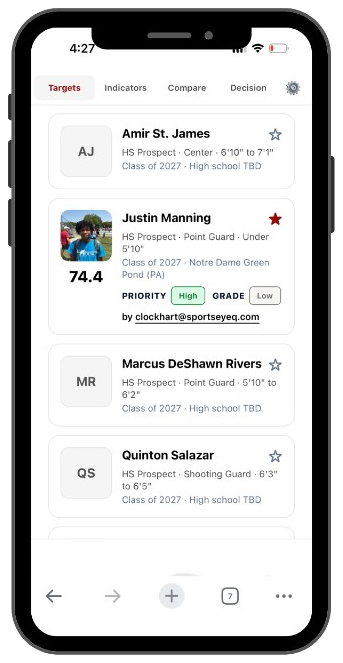
Build the board
Put next-season targets, longer watchlist names, and roster players in one place. A coach opens a player and evaluates — Quick Pass or full look — instead of rewriting the same notes later.
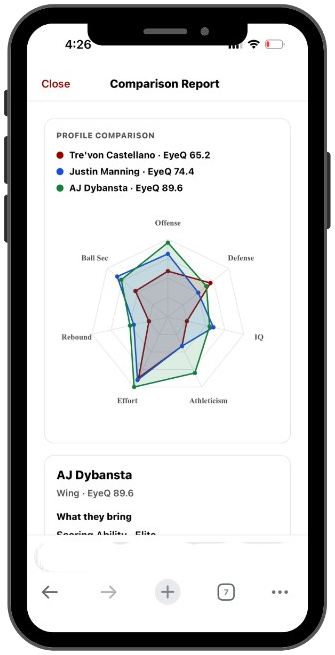
Put looks side by side
Staff compare submitted evaluations on one consistent scale — so the room debates players, not whose paragraph was clearer.
See who stands out — and who you’re chasing
Relative talent on your board (Grade) sits next to chase intent (Priority). The war-room view ranks what your staff already evaluated.
Needs, chase list, and the money together
Declare what the roster still needs. See who covers those spots and who you’re prioritizing. Attach NIL, scholarship, and revenue-share packages to the same EyeQ — so cost and talent share one conversation.
Worth. Cost. Chase. Same language.
Evaluation software exists. Spreadsheets for NIL and scholarships exist. Turning one coach’s eye into clearer roster decisions — talent, chase, and cost together, with the budget you already have — does not. That is what this is.
Talent as you see it
EyeQ captures the look. Grade shows where that player sits relative to the rest of your board this cycle.
Chase without the rewrite
Priority tells the room how hard you’re going — without asking an assistant to rebuild the sheet after every gym.
Money next to the eye
Packages live beside the same evaluation — so you spend the money you already have on better decisions, not a second late-night budget conversation.
Built for the people carrying the recruiting load.
You hired evaluators, not report writers.
Your staff sees the game differently — that is why you hired them. When a coach evaluates, the room gets the evaluation, the chase signal, and the business picture without asking anyone to write it up twice or rebuild the money on the side.
Same conversation. Clearer picture.
When you need the money and the coach’s eye in one place — cost, talent, and priority together — without waiting on another spreadsheet.
Your eye. Your board. Your seat.
Personal accounts for people who evaluate on their own — independent scouts, agencies, and management groups who need the same habit without a full college staff install.
Your coaches already know who’s good. The Basketball Business System captures that eye, kills the paperwork around it, and never touches the judgment.The line we will not cross
Run the next board meeting without rebuilding the sheet.
Same eye. Same judgment. The habit is evaluating once so talent, chase, and compensation stay in one language — and better decisions follow with the budget you already have. Programs and individual scouting seats. Ten minutes is enough to know whether it fits.